
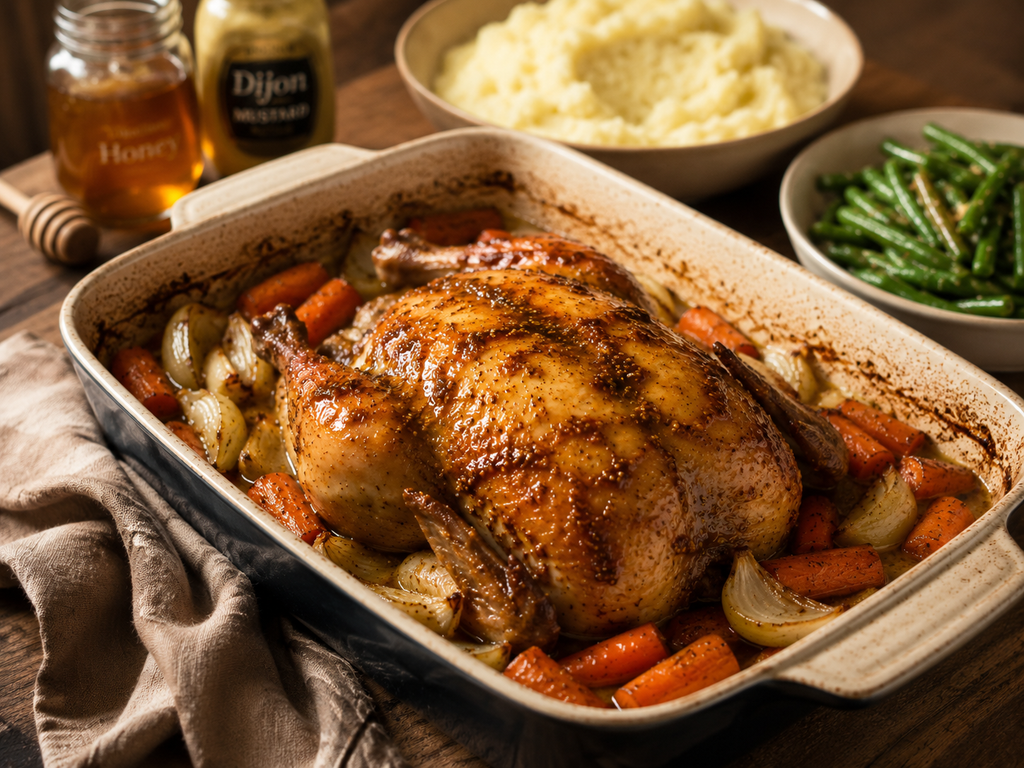
This is one of our favorite chicken roast recipes, and we have many.
When my best friend came to visit after we brought the twins home, life was pretty much one continuous rotation of feeding a baby, burping a baby, changing a baby—and then realizing it was already time to feed somebody again.
At some point in the middle of all of that, dinner needed to be made.
I told my friend I would be back in 15, “let me just get dinner in the over.”
When dinner was done and my friend realized I made a whole chicken roast in those 15 minutes I was in the kitchen, she was shook… and immediatly needed the recipe.
Not because it was some elaborate dinner. Quite the opposite. I think she was looking around at the newborn chaos happening in my house and wondering how on earth I had decided now was the time to casually roast an entire chicken.
But that’s the funny part: this is one of my easy dinners.
I roast a whole chicken all the time, and this honey-Dijon version is one of my favorites. Once you know the basic formula, you can change almost everything about it—the seasonings, the vegetables, the sauce, whatever needs to be used up in the fridge. I have so many different versions of this meal that they’ll eventually make their way onto this site.
And one chicken usually gives us more than one meal. We ate this one for dinner that night, and the next day I used the leftover chicken to make honey-mustard chicken salad for sandwiches.
That’s probably why I love roasting a whole chicken so much. It looks like you really did something. In reality, the oven did most of it.
And when you’re taking care of newborn twins, that’s exactly the kind of cooking I’m interested in.
A Few Notes Before You Start
- Chicken size matters. This recipe is written for approximately a 4–5 lb whole chicken. A larger or smaller bird will change the cooking time.
- Trust the thermometer, not the clock. Roast times are estimates. Poultry should reach a safe internal temperature of 165°F in the appropriate locations before serving.
- Keep an eye on the skin. Starting at 450°F helps with browning. If the chicken gets darker than you’d like while it finishes cooking at 375°F, loosely tent it with foil.
- Gravy thickness is personal. Start with the listed slurry and add more only if needed. It will continue to thicken slightly as it cools.
- Taste before adding more salt. The seasoning, Dijon, broth and concentrated pan juices all contribute saltiness.
- Let it rest. Give the chicken 10–15 minutes before carving so you don’t lose all those juices onto the cutting board.
Use What You Have.
I am firmly on team use what you have. A missing ingredient does not automatically require an emergency grocery-store run. Here are a few ways to make this recipe work with what’s already in your kitchen.
NO HOMEMADE BONE BROTH?
Use store-bought chicken broth or stock. I use homemade because I roast a chicken almost every week and freeze the broth, but this recipe absolutely does not require you to have a freezer full of homemade stock.NO JARLIC?
Fresh garlic works too. And yes, I use garlic from a jar all the time. This is a judgment-free garlic-peeling zone.NO CELERY SEED?
Leave it out. It adds a nice savory note, but the chicken will survive without it.NO FRESH HERBS?
Neither do I, most of the time. Dried thyme works beautifully here. If you happen to have fresh herbs, great—use them. Don’t make a special grocery trip on my account.Make it yours: Taste the honey-Dijon mixture before it goes on the chicken. Want it sharper? Add a little more Dijon. Sweeter? Add a touch more honey. Just remember that the flavors will mellow and concentrate as everything roasts.

Ingredients
Equipment
Method
- Preheat the oven to 450°F.
- Pat the chicken very dry with paper towels. Place it breast-side up in a large roasting pan.
- Arrange the carrots and onion around the chicken. Place the lemon halves inside the chicken cavity.
- In a small bowl, whisk together the Dijon mustard, mayonnaise, honey, jarred garlic, olive oil, onion powder, garlic powder, paprika, celery seed, thyme, salt, and black pepper.
- Rub the honey-Dijon mixture all over the chicken, including the legs and sides. Spoon or brush a little over the carrots and onions.
- Pour 1 cup chicken bone broth or chicken broth into the bottom of the roasting pan, being careful not to pour it directly over the chicken.
- Roast uncovered at 450°F for 15 minutes.
- Reduce the oven temperature to 375°F and continue roasting for approximately 40 minutes, or until the chicken reaches a safe internal temperature of 165°F. Begin checking early, since cooking time will vary depending on the size of the chicken and your oven.
- Remove the chicken from the oven and transfer it to a cutting board or platter. Loosely tent with foil and allow it to rest for 15 minutes before carving.
- While the chicken rests, use the drippings and cooking liquid in the roasting pan to make the gravy.
- If your roasting pan is stovetop-safe, place it directly over medium heat. Otherwise, carefully pour the drippings and cooking liquid into a saucepan.
- Stir in 1 tablespoon Dijon mustard. Add additional chicken bone broth or chicken broth as needed to reach your desired amount of gravy.
- In a small bowl, whisk together 1 tablespoon cornstarch and 2 tablespoons cold water until completely smooth.
- Slowly whisk the cornstarch slurry into the simmering pan liquid. Cook for 2–3 minutes, whisking frequently, until the gravy thickens. Add additional slurry only if needed.
- Taste and season with salt and black pepper as needed.
- Carve the rested chicken and serve with the roasted carrots and onions, spooning plenty of warm honey-Dijon pan gravy over everything.
Notes
Leftovers are the best part.
STORE
Remove the chicken from the bones and refrigerate it in an airtight container for up to 3–4 days. Store the gravy separately if you can—it makes reheating much easier.
REHEAT
For individual portions, add a spoonful of gravy or broth before reheating so the chicken stays moist. Microwave until steaming hot, or cover and warm gently in the oven.
FREEZE
Shredded or carved chicken freezes beautifully for future meals. Freeze in an airtight container with a little broth or gravy for up to 3–4 months for best quality. Thaw overnight in the refrigerator before reheating.
Don’t toss the bones. If you’re already roasting a whole chicken, you might as well get another meal out of it. I save the carcass and make bone broth, freeze it, and then use that broth the next time I roast a chicken. It’s basically the circle of chicken.
Nutrition
Nutrition information is an estimate based on 6 servings and will vary depending on the size of the chicken, ingredients used, portion size and amount of pan gravy served.
| Calories | ~520 kcal |
| Protein | ~48 g |
| Carbohydrates | ~19 g |
| Fat | ~27 g |
| Fiber | ~3–4 g |
| Sugar | ~11 g |
Leave a Reply